
lime
The Engine Behind The Follow-Up

A CRM and automation system that keeps every lead captured, routed, followed up, and visible

Most teams own a CRM and still chase leads by memory. This system fixes the operation behind your sales instead of handing you another tool to manage. We set up the CRM so every lead lands in one place, build the automation that follows up without anyone having to remember, and apply AI to the specific jobs where it earns its keep.

The Category, Defined

What a CRM and automation system actually is

A CRM and automation system is the operating layer for your leads and customers: where every contact is recorded, every follow-up is triggered, and every handoff between marketing and sales happens without manual effort.

Owning CRM software gets you partway. Plenty of businesses pay for a CRM that sits half-empty, used as a contact list and little else. The system is what turns that tool into something the business actually runs on. It captures leads from every source, moves them through defined stages, fires the right follow-up at the right time, and reports on all of it, so the work that used to live in people's heads and inboxes lives somewhere reliable instead.

Why It Stalls

The problem this solves

Sales operations break down in quiet ways: a CRM nobody updates, follow-up that happens only when someone thinks of it, and hours each week lost to copying data between tools. Deals fall through the cracks between marketing and sales, and no one notices until the pipeline looks thin.

None of this comes down to effort. Hardworking teams lose deals to these gaps every day. A lead comes in over the weekend and gets a reply on Tuesday. A promising prospect goes quiet and no one follows up because the reminder lived in someone's memory. A rep spends the first hour of the day retyping form submissions into the CRM instead of selling. The cost is real and rarely measured, because the deals you lose this way never show up as losses. They just never become anything.

A real example

MG Law was generating inquiries through forms and phone calls, but the firm had little visibility into what happened after a lead arrived. The team needed a simple way to log, triage, assign, and review each inquiry before it moved into the legal management system. Without that intake layer, the firm could not reliably connect its marketing to lead quality, follow-up speed, or real business opportunity.

The fix was not more PPC or more SEO. It was a simple CRM-style intake system that captured every inquiry, organized the handoff, and showed the firm which leads were worth acting on fast.

What It Does To The Work

How the system works

The system changes the daily work in four ways. Each one removes a task your team should not be doing by hand, and together they keep every lead moving without anyone holding it all in their head.

01

Capture every lead in one place

The first job is making sure nothing lands outside the system. We set up and clean the CRM, design the pipeline stages, and connect your forms, calls, and channels into it, so every lead arrives as a record with its source attached instead of a note someone meant to enter later.
02

Automate the follow-up so nothing waits on a person to remember

Follow-up runs on triggers built into the system. New leads get routed to the right person, sequences go out on schedule, and reminders fire when a deal goes quiet, so the prospect hears from you fast and keeps hearing from you until there is an answer.

03

Apply AI where it speeds real work

AI handles specific jobs inside the system. It drafts a first response in seconds, cleans up reporting, and speeds content workflows that used to take an afternoon. The test for adding it is simple: it has to make a real task faster or better, or it stays out.

04

Turn activity into reporting you can act on

Reporting is automated and built to answer questions. You see where deals get stuck, which stages leak, and how fast leads are being worked, so your next decision rests on what the pipeline is doing instead of a gut read.

Proof, Not A Mockup

The intake engine we built for MG Law

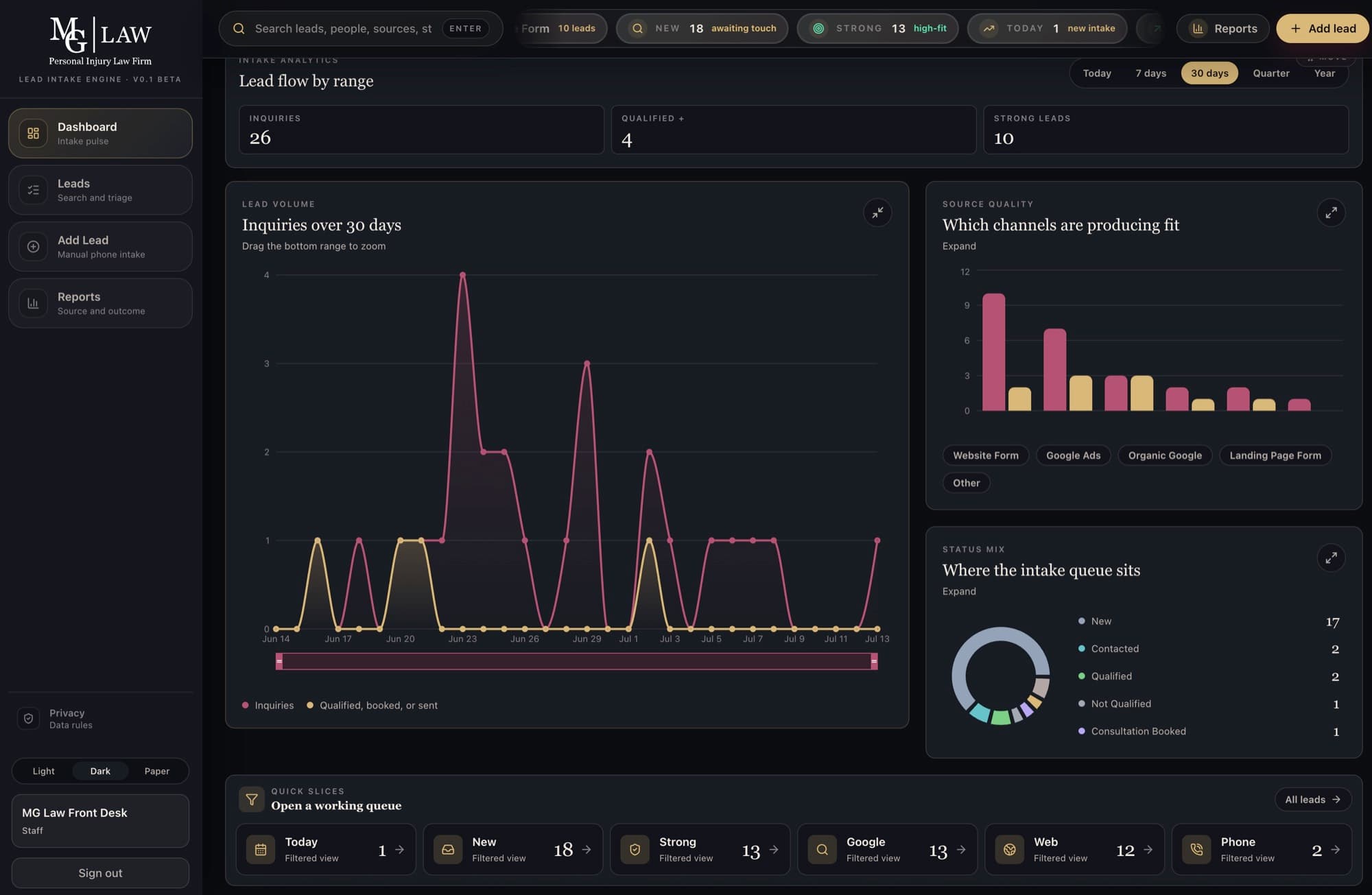
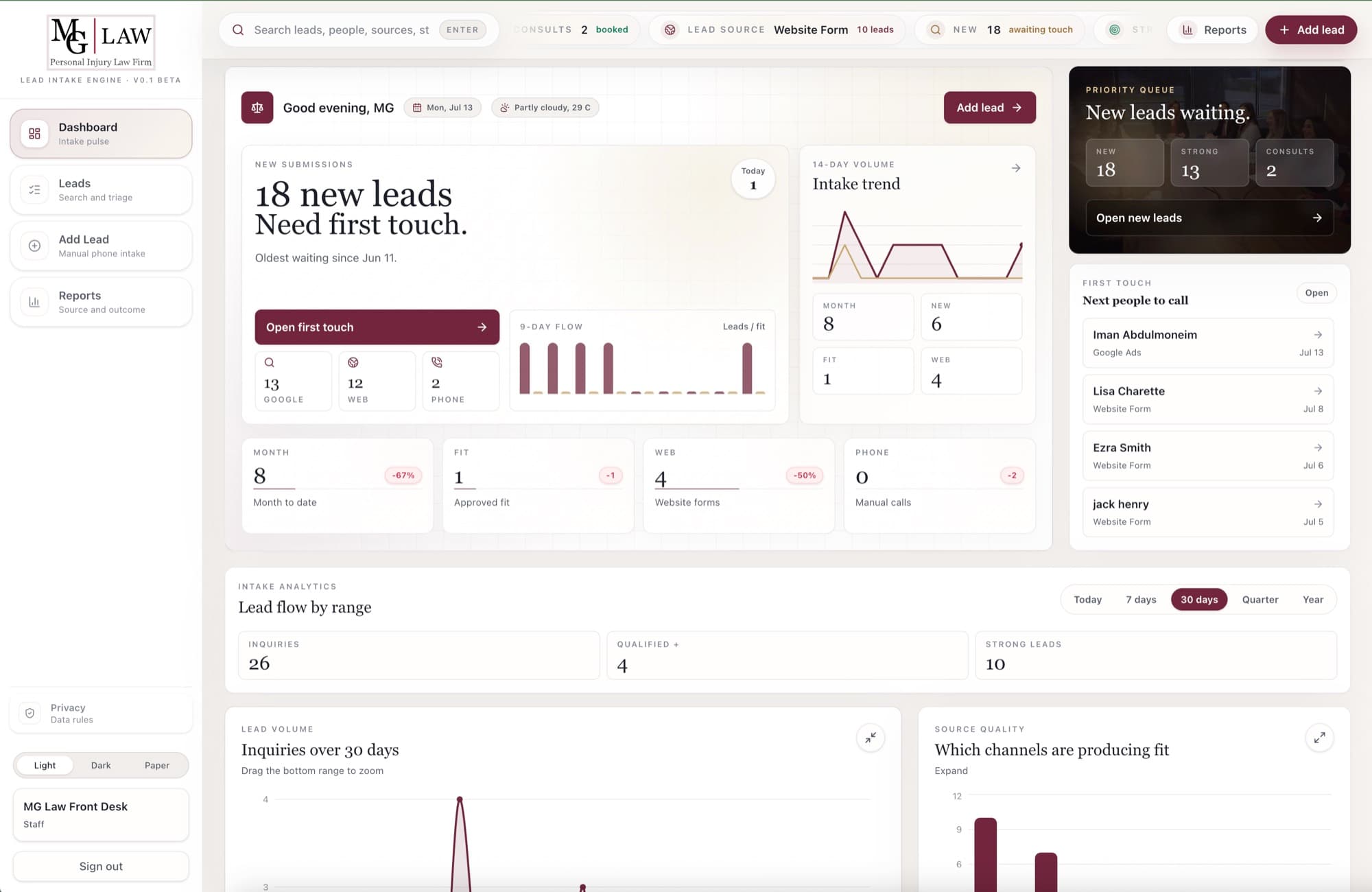
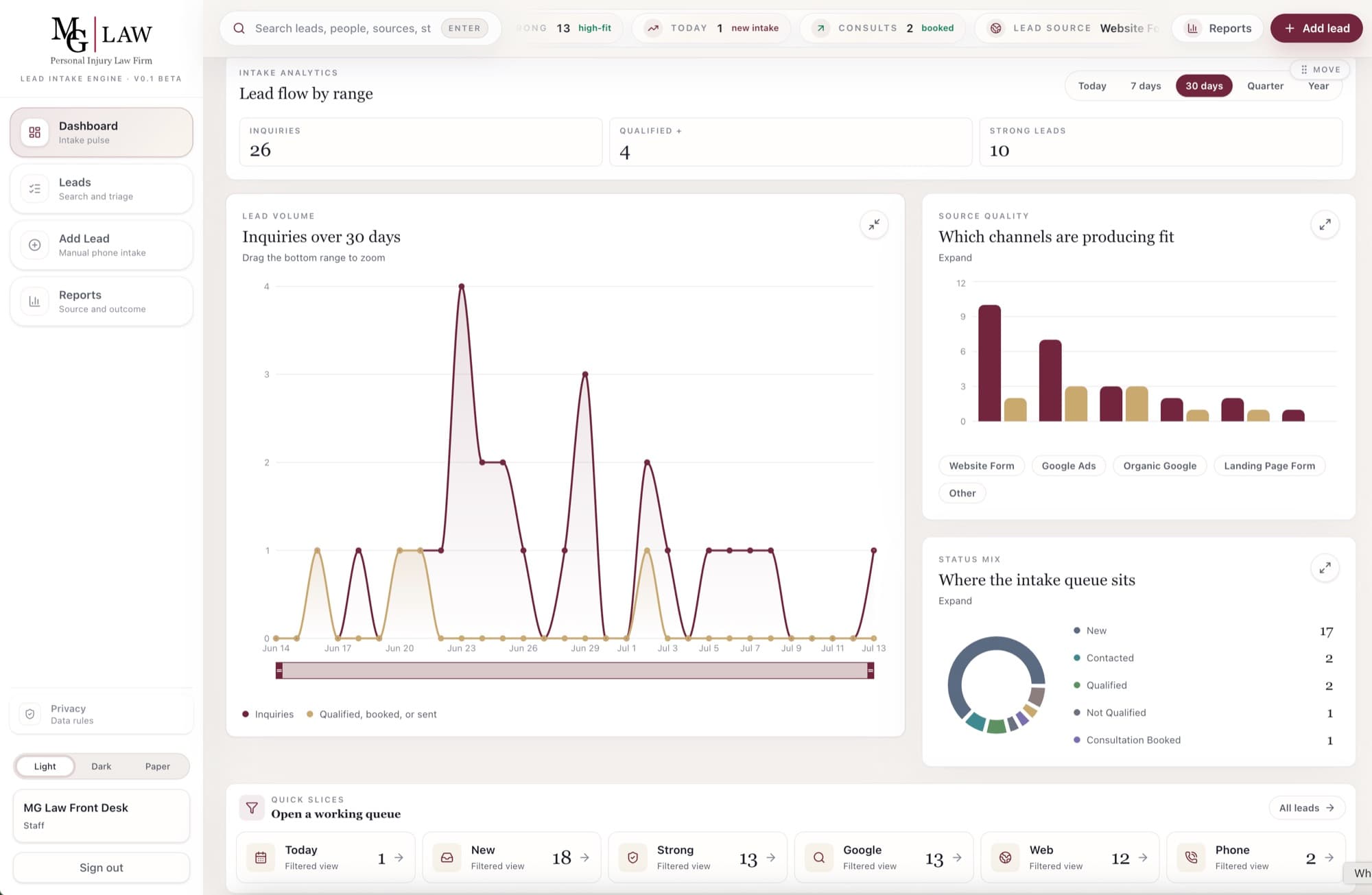
This is a live view of the custom Lead Intake Engine we designed and built for MG Law, a personal injury firm. Every website form and phone inquiry lands here as a tracked record, routed to the right person, with source attribution and a first-touch queue, so nothing waits on memory and the firm can see lead quality at a glance.

mglaw · lead intake engine
MG Law Lead Intake Engine dashboard: 18 new leads needing first touch, a priority queue, next people to call, and intake analytics by source
The intake pulse: new submissions, a priority queue, and the next people to call, all in one view.
intake analytics
MG Law intake analytics: inquiries over 30 days, which channels are producing fit, and where the intake queue sits by status
Lead flow, source quality, and pipeline status in one report.
same system, dark mode
The same MG Law intake analytics view rendered in a dark theme
Built to the firm's brand, in light, paper, and dark themes.
A Practical Line On AI

Where AI fits, and where it does not

AI belongs on the tasks where speed and volume matter and a human check is easy: a fast first reply, a reporting summary, a content draft to edit. It does not belong on the judgment calls, the relationships, or the decisions a customer would be upset to learn a machine made alone.

A lot of agencies sell AI as the product. We treat it as one tool inside a system that works without it. The follow-up, the pipeline, and the reporting all stand on their own, and AI makes parts of them quicker. That order matters, because a business that bolts AI onto a broken process just gets to its mistakes faster. Fix the operation first, then let AI take the load off the parts that genuinely benefit.

A Clear Line On AI

What we automate, and what should stay human

Automation earns its place on the repetitive, rules-based work where speed matters and a mistake is easy to catch. The judgment, the relationships, and the sensitive calls stay with people.

What we automate

  • Lead routing to the right owner
  • Follow-up reminders and sequences
  • Data movement between tools
  • Reporting preparation
  • Repeatable follow-up support

What stays human

  • Strategy and prioritization
  • Sales conversations
  • Relationships
  • Sensitive communication
  • Decision-making
What You Get

What's included

The components below make up the system. Most engagements start with the CRM itself, since the rest depends on it being set up properly.

  • CRM setup, cleanup, and pipeline design
  • Form, call, and lead source routing into the CRM
  • Automated follow-up, lead routing, and reminders
  • Practical AI for response speed, content workflows, and reporting
  • Integration with existing marketing, sales, ecommerce, CRM, ERP, or operational tools where relevant
  • Dashboarding, lead quality visibility, and business intelligence reporting
What Changes Day To Day

The outcome you can expect

Leads get the same fast, consistent follow-up, designed to hold up when someone is busy or out. The hours your team used to spend shuffling data between tools come back, and the deals that once died in the gap between marketing and sales keep moving. Your team gets that time back for the work that closes business.

The Right Fit

Who this is for

This system fits any business sitting on a CRM it barely uses, struggling with follow-up that only happens when someone has a spare moment, or watching a capable team lose hours to manual work. The trigger is usually a feeling that opportunities are slipping through and the tools meant to catch them are not pulling their weight.

Real Team Numbers

What this has done for other clients

MG Law

From lead generation to intake visibility

MG Law had already grown inquiry volume through digital marketing and website conversion work. The next bottleneck was operational: every form and phone inquiry needed to be logged, reviewed, assigned, and understood before it reached the firm's legal management system. Lime's recommended next step was an intake visibility layer connecting website forms, phone inquiries, receptionist intake, lead source tracking, triage fields, and status visibility into one system.

Result: The value is practical: clearer view of lead quality, faster internal handoff, accurate source attribution, and less reliance on memory or scattered notes.

AiFA Labs

The infrastructure behind an AI-ready demand engine

AiFA Labs needed the infrastructure to support visibility, conversion, reporting, and future pipeline growth across North America, not just campaign activity. Lime deployed 90+ SEO and LLM-readiness updates, structured data across 66+ blog posts, 100% site-wide canonical coverage, campaign landing pages, event activation, reporting visibility, and HubSpot-aligned tracking.

Result: A stronger operating layer for demand generation: clearer visibility, better technical readiness, more structured campaign paths, and a measurable foundation for future pipeline development.

90+
SEO & LLM-readiness updates
66+
Blog posts schema-enabled
100%
Canonical coverage

Lime internal systems

Automation to scale delivery

Lime applies the same logic to its own work. Reporting, proposal creation, case study development, audit checklists, content workflows, and sales pipeline follow-up are being structured so the agency runs its own growth system, not only sells one. The tools that cut manual work for clients do the same inside Lime, improving speed, consistency, and follow-up.

A Clear Sequence

How we build it

Every system follows the same five steps, so you know what happens before any work begins. We audit how leads and follow-up move through your business today, find the gaps where time and deals are lost, build the roadmap, build the system, manage it as it runs, and refine it against real performance.

01

Audit

02

Roadmap

03

Build

04

Manage

05

Optimize

See our full method
How It Gets Delivered

Built by one connected Lime team

Strategy, creative, marketing, development, automation, analytics, and reporting work from one shared plan. Lime is led by experienced leadership and delivered as one accountable partner, so nothing falls into the gaps between separate vendors.

Strategy
Creative
Marketing
Development
Automation
Reporting
Find The Bottleneck First

Start with an audit

You do not have to guess why deals are falling away or where the manual work is piling up. The Growth System Audit reviews how your CRM, follow-up, and reporting work today, shows you where the operation is losing time and opportunities, and tells you whether this is the system to build first.

FAQ

Questions about CRM and automation

We work with the CRM you already run rather than pushing one platform, whether that's HubSpot, a legacy system, or something in between. The work is in setting it up properly and connecting it to your forms, calls, and channels, not in the brand name on the software. Where a business has no real CRM yet, we recommend and configure one that fits how the team actually sells, so the system matches the operation instead of forcing the operation to match the tool.

No. Most engagements start by making the CRM you already own actually work, since the problem is usually setup and adoption, not the software. A CRM sitting half-empty as a contact list doesn't need replacing; it needs the pipeline stages, lead routing, and follow-up built around it so the team runs on it. We suggest a change only when the current tool actively blocks tracking or follow-up, not as a default.

The tasks that are safe to automate are the repetitive, rules-based ones where a mistake is easy to catch: lead capture into the CRM, routing to the right person, scheduled follow-up sequences, and reminders when a deal goes quiet. These remove work that shouldn't depend on someone remembering, without touching the judgment calls. What stays manual is anything involving relationships, negotiation, or a decision a customer would be upset to learn a machine made alone. The rule is simple: automate the handoffs and the reminders, keep the human on the judgment.

AI belongs on the parts of follow-up where speed and volume matter and a human can easily check the output: drafting a fast first response, summarizing a lead's history, or cleaning up reporting. It shouldn't send unreviewed messages on the relationship-sensitive touches or make the call on which deals to prioritize. The test is whether it makes a real task faster or better with a human still in the loop; a first-draft reply that a person approves in seconds passes, an autonomous decision about a customer does not.

Leads stop falling through the cracks when every inquiry lands in the CRM as a tracked record the moment it happens, gets routed to an owner, and triggers follow-up that doesn't wait on anyone's memory. Most lost deals aren't lost to effort; they're lost to gaps, like a weekend inquiry answered Tuesday or a quiet prospect no one circled back to. Automating capture, routing, and reminders closes those gaps, and reporting shows where deals stall so a leak gets caught while it still matters rather than after the pipeline looks thin.